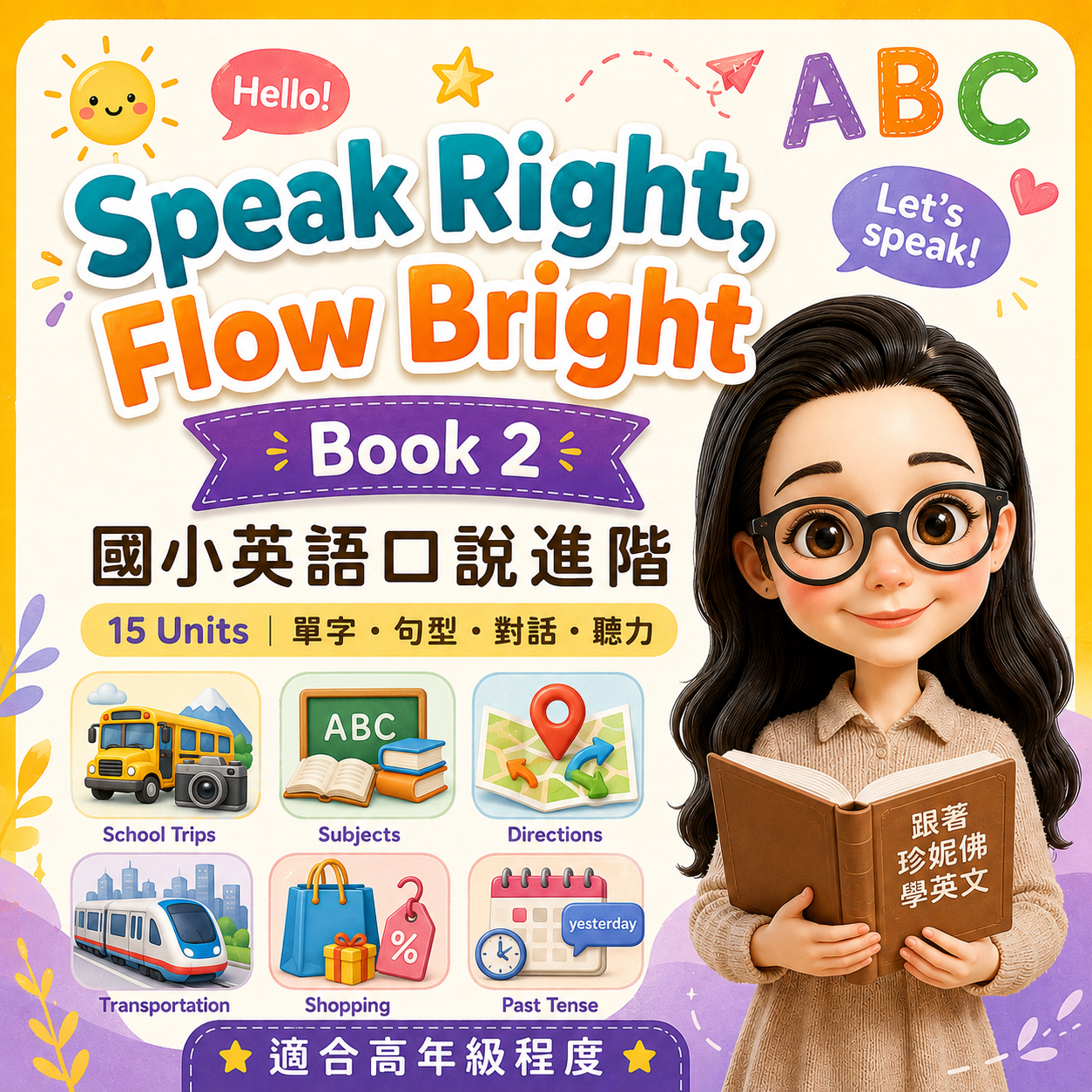
📘《Speak Right, Flow Bright (2)》全書字彙與句型完整整理
Unit 1: Vacation & School Trips (假期與校外教學體驗)
- 基本單字量:15 個
- hill, trail, special, ice cream, fish balls, souvenirs, keychains, postcards, new friends, tour guide, swim, lake, cold, group photo, enjoy
- 基礎句型:8 組
- Did you ride the bus with your friends? / Yes, I sat next to Tim and we played games.
- What did you see at the market? / I saw a fruit stand and a toy shop.
- Did you buy anything? / Yes, I bought a pineapple cake!
- Did you climb a small hill or a big mountain? / No, I just walked on the trail.
- Did she eat anything special? / Yes, she ate ice cream and fish balls.
- Did they buy souvenirs? / Yes, they bought keychains and postcards.
- Did you meet any new friends during the trip? / Yes, I met a very friendly tour guide.
- Did you swim in the lake? / No, the water was too cold.
- 🌟 延伸對話能力(情境引申):
- 過去經驗的流暢敘述: 熟練運用過去式(sat, played, saw, bought)分享旅途細節。
- 日常觀察與選擇: 描述校外教學中所見的人事物與特定飲食嘗試。
- 旅遊社交與互動: 詢問他人旅行中的趣事、購買的紀念品及人際互動。
Unit 2: Talking About Favorite Subjects (談論最喜歡的科目)
- 基本單字量:14 個
- art, Chinese, English, math, music, PE (Physical Education), science, social studies, favorite, subject, his, her, our, their
- 基礎句型:10 組
- What’s your favorite subject?
- His favorite subject is science.
- Their favorite subject is music.
- Is your favorite subject math? / Yes, it is.
- Is her favorite subject social studies?
- No, it isn’t. Her favorite subject is Chinese.
- Do they like science? / Yes, they do. They think it’s fun!
- Does Eric like math? / No, he doesn’t. He likes music more.
- What’s his favorite subject? / His favorite subject is art. He draws very well!
- What subject does he like? / He likes social studies. He thinks it’s interesting.
- 🌟延伸對話能力(情境引申):
- 國一核心「所有格」轉換: 靈活切換單複數所有格(his, her, our, their)來談論他人偏好 。
- 表達對學科的看法: 使用進階形容詞(fun, interesting)並搭配動詞 think 補充理由 。
- 才藝特長與偏好對比: 用比較級形容詞表示更喜歡某學科(He likes music more) 。
Unit 3: Talking About Places & Directions (談論地點與方向)
- 基本單字量:26 個
- bank, bookstore, library, museum, park, post office, supermarket, restaurant, hospital, school, movie theater (US), cinema (UK), police station, bakery, hotel, zoo, road, street, excuse me, next to, across from, go straight, left side, after school, in front of, nearby
- 基礎句型:10 組
- Where are you going?
- I’m going to the library.
- We’re going to the supermarket.
- She’s going to the museum.
- Where’s the park? / It’s on Brown Street.
- Where’s the library? / It’s on Main Street.
- Where’s the hotel? / It’s on Green Road.
- Where’s the post office? / It’s next to the bank.
- Is the restaurant far from here? / No, it’s very close.
- Excuse me, where is the police station? / It’s across from the park.
- 🌟 延伸對話能力(情境引申):
- 日常放學生活銜接: 表達放學後的目的地與特定目的(I’m going to the library to return some books.) 。
- 街區位置與道路命名表達: 準確使用介系詞 on 接有名稱的街道、路名 。
- 問路與距離感詢問: 運用社交禮貌用語詢問距離遠近(Is it far from here? / No, it’s nearby.) 。
Unit 4: Talking About Transportation (談論交通工具)
- 基本單字量:16 個
- bicycle (bike), bus, car, MRT, airplane, motorcycle, taxi, train, subway, ride a bike, take a bus, drive a car, take a train, ride a motorcycle, walk, arrive
- 基礎句型:10 組
- How can we get to the park?
- We can get there by bike.
- Can you get to the park by bike? / Yes, we can.
- Can we get to the park by train?
- No, you can’t. You can get there by bus.
- How can I get to the zoo? / You can get there by bus.
- Can we get to the bookstore on foot? / No, we can’t.
- Can we get to the zoo by train? / No, we can’t. We can get there by bus.
- How can she get to the museum? / She can get there by taxi.
- Can we get to the airport by scooter (motorcycle)? / No, we can’t. We can get there by car.
- 🌟 延伸對話能力(情境引申):
- 國一核心助動詞問答: 熟練運用 can 進行方式詢問、能力許可與替代方案的流暢應答 。
- 「搭乘交通工具」的兩種用法切換: 熟練將 by + 交通工具 與 on foot 交叉運用於口說情境 。
- 出門與長途旅行規劃: 在實際生活中能針對如機場、動物園等遠程地點給予合理的交通建議 。
Unit 5: Shopping & Prices (購物與多少錢?)
- 基本單字量:18 個
- dress, skirt, sweater, T-shirt, pants, shorts, sneakers, socks, jacket, coat, hat, scarf, gloves, boots, jeans, belt, pajamas, uniform
- 基礎句型:10 組
- How much is the dress?
- It’s x hundred dollars. (e.g., It’s nine hundred dollars.)
- They’re four hundred and fifty dollars.
- How much are the pants?
- They’re six hundred and seventy dollars.
- How much are the gloves?
- They’re one hundred and fifty dollars.
- It’s nine hundred and twenty dollars.
- They’re eight hundred dollars.
- It’s three hundred and fifty dollars.
- 🌟 延伸對話能力(情境引申):
- 國一必修「單複數名詞」價錢區分: 掌握單數(dress/sweater $\rightarrow$ Is/It’s)與複數名詞(pants/sneakers/gloves $\rightarrow$ Are/They’re)的文法關鍵 。
- 百位數與十位數大型數字口說: 靈活聽說 100 到 999 之間的百位數英文金額表達 。
- 氣候與穿搭需求聯想: 結合天氣情境表達購物需求(It’s really cold today. I need a jacket and a scarf.) 。
Unit 6: Whose Is This? (這是誰的?)
- 基本單字量:13 個
- jacket, smartphone, umbrella, watch, water bottle, key, glasses, wallet, backpack, notebook, lunchbox, hat, camera
- 基礎型:10 組
- Whose jacket is it?
- Whose glasses are they?
- Whose smartphone is it?
- Whose keys are they?
- They’re my dad’s keys.
- It’s Lily’s backpack.
- Whose shoes are they? / They’re Kevin’s shoes.
- Whose water bottles are they?
- They’re our water bottles.
- Whose pencil case is it? / It’s my pencil case.
- 🌟 延伸對話能力(情境引申):
- 國一核心「Whose 疑問句」與「名詞所有格」: 徹底釐清 Whose 後接單/複數名詞的變化(Whose key vs. Whose glasses),並能加上撇 s(Lily’s / dad’s)或所有格(our/my)回答 。
- 失物招領情境演練: 在日常校園或公共場所遺漏物品時的互助對話(Someone left their glasses on the bench.) 。
- 物品細節特徵描述: 在對話中描述物品顏色或皮帶特徵以確認失主(My watch band is black.) 。
Unit 7: I Don’t Feel Well! (我覺得不舒服!)
- 基本單字量:21 個
- fever, runny nose, toothache, headache, leg, foot (單數), feet (複數), hand (單數), hands (複數), eyes (複數), wrong, hurt, stomachache, sore throat, back, arm, knee, ear, cold, sick, tired
- 基礎句型:10 組
- What’s wrong? / I have a runny nose.
- What’s wrong? / He has a headache.
- What’s wrong? / You look tired.
- What’s wrong? / She has a fever.
- What’s wrong? / They have a cold.
- What’s wrong? / We are tired.
- What’s wrong? / You look tired.
- Are you okay? / Not really. My stomach hurts.
- What’s wrong? You’re holding your ear.
- What’s wrong? / You look tired.
- 🌟 延伸對話能力(情境引申):
- 國一核心「身體部位單複數 + 動詞單複數」: 掌握第三人稱單數部位用 hurts(My stomach hurts)與複數部位用 hurt(My feet hurt)的語感 。
- 生病生理狀態雙重描述: 能流暢接續兩種不適症狀(I have a sore throat, and my head hurts too.) 。
- 看診角色扮演遊戲: 模擬醫生與病人間的關懷與互動,學會禮貌回應醫生的建議 。
Unit 8: Where Are You From? (你來自哪裡?)
- 基本單字量:9 個
- Australia, India, Japan, Singapore, Spain, Taiwan, the UK, the USA, South Korea, come from / be from
- 基礎句型:10 組
- Where are you from? / I’m from Taiwan.
- Where is he from? / He’s from the UK.
- Where is she from? / She’s from the USA.
- Where are they from? / They’re from Australia.
- Are you from South Korea? / Yes, I am.
- Are you from Japan? / No, I’m not.
- Is he from the UK? / No, he’s from the USA.
- Are they from India? / No, they’re from Spain.
- Hi, I’m Kevin! What’s your name?
- I’m from the USA. What about you?
- 🌟 延伸對話能力(情境引申):
- 高階國際社交自我介紹: 在初次見面時,流暢結合姓名、問候語與國家來源(Nice to meet you! Where are you from?) 。
- 國一必修「國家冠詞用法」: 區分一般國家名(Taiwan, Japan)與需加定冠詞的國家名(the UK, the USA)之正確口說讀音 。
- 國籍猜謎配對互動: 藉由 Yes/No 問句來引導對方進行多國籍的消去法猜謎遊戲 。
Unit 9: What Do You Do on Weekends? (你週末在做什麼?)
- 基本單字量:20 個
- go jogging, play baseball, play basketball, ride a bike, listen to music, study English, surf the Internet, watch TV, weekend, free time, read books, play video games, go shopping, cook, draw, walk the dog, go camping, clean my room, take a nap, hang out with friends
- 基礎句型:10 組
- I go jogging on weekends.
- What do you do on weekends?
- He watches TV in his free time.
- What does he do in his free time?
- What does she do in her free time?
- She studies English in her free time.
- What do they do in their free time?
- They play basketball in their free time.
- What does he do on weekends?
- He surfs the Internet on weekends.
- 🌟 延伸對話能力(情境引申):
- 國一核心「現在簡單式」第三人稱單數: 確實掌握一般動詞加上 s/es(watches, surfs, studies, goes)的發音與規律變化 。
- 區分平日空閒與週末活動: 精準區分 on weekends(在週末)與 in one’s free time(在某人的空閒時間)的句尾時間修飾詞用法 。
- 週末生活趣味賓果: 與同學利用 AI 或課堂小遊戲進行週末休閒生活問答互動 。
Unit 10: What Time Do You…? (你幾點在……?)
- 基本單字量:10 個
- get up, go to school, eat lunch, go home, do homework, take a shower, go to bed, brush teeth, wash face, eat breakfast
- 基礎句型:10 組
- What time do you get up?
- What time does she do her homework?
- What time does she go to bed?
- What time does he have lunch?
- Do you have lunch at twelve?
- Do you have lunch at twelve?
- Does she have lunch at twelve?
- Does he study English at eight PM?
- Do they go to bed at 10:00?
- No, they don’t. They go to bed at 9:30.
- 🌟 延伸對話能力(情境引申):
- 時間副詞與 AM/PM 表達: 在日常對話中精準加入具體時間點、早晚區分(at 5:30 PM / at 9:30) 。
- 國一必修助動詞 Do 與 Does 的區隔: 面對不同人稱時,能直覺反應並流暢進行日常時間作息的否定與肯定應答 。
- 個人時間 schedule 猜謎: 運用消去法問句精準猜測對方的作業、作息或睡覺時間點 。
Unit 11: What Do You Want to Be? (你想成為什麼?)
- 基本單字量:20 個
- artist, dentist, farmer, singer, writer, basketball player, bus driver, police officer, teacher, doctor, nurse, chef, waiter, waitress, mailman, firefighter, vet, student, actor, actress
- 基礎句型:10 組
- I want to be a police officer.
- She wants to be a dentist.
- They want to be police officers.
- Tom wants to be a singer.
- What does Amy want to be?
- Do you want to be a writer?
- Do they want to be farmers?
- Does Tom want to be a singer?
- Does Amy want to be a singer?
- No, she doesn’t. She wants to be a dentist.
- 🌟 延伸對話能力(情境引申):
- 國一核心「不定詞 to + 原形動詞」與「職稱複數」: 學習 want 後面接 to be a/an + 單數職稱 或是 to be + 複數職稱(police officers) 的進階文法結構 。
- 生涯職業聯想與討論: 討論自己與周遭朋友、家人的未來夢想職業,並能為不同人稱進行代換 。
- 夢想職業猜猜看: 透過工作特徵的線索提示,引導對方用 Does he/she want to be… 來猜測夢想職業 。
Unit 12: Where Were You? (你在哪裡?過去時態篇)
- 基本單字量:12 個
- two days ago, yesterday, last night, two hours ago, an hour ago, yesterday afternoon, coffee shop, movie theater, night market, sports center, buy (bought), eat (ate)
- 基礎句型:10 組
- Where were you two days ago?
- Where were they yesterday?
- Were you at the bakery an hour ago?
- Were you at the bookstore an hour ago?
- Were they at the supermarket last night?
- Were you at the restaurant last night?
- Was your sister in the bathroom an hour ago?
- Was your father in the living room two hours ago?
- Where was your mother an hour ago?
- Was Tom at the bookstore last night?
- 🌟 延伸對話能力(情境引申):
- 國一最關鍵「Be 動詞過去式(Was/Were)」: 本單元正式邁入國一最核心的過去時態!徹底釐清 I/He/She/Was 與 You/They/We/Were 的時間差與肯定否定句(No, we weren’t. We were at the park.) 。
- 結合過去時間副詞: 熟練將地點問句與時間修飾詞(ago / last night / yesterday)流暢串聯 。
- 神祕行蹤猜謎(AI對話): 詢問他人過去某個特定時間點的地點,並分享當時吃了或買了什麼(What did you eat?) 。
Unit 13: What Did You Do Yesterday? (你過去做了什麼?)
- 基本單字量:20 個
- a few minutes ago, this morning, this afternoon, last Friday, last weekend, last week, last month, last year, play (played), watch (watched), visit (visited), clean (cleaned), cook (cooked), learn (learned), walk (walked), dance (danced), have (had), go (went), buy (bought), do (did)
- 基礎句型:10 組
- What did you do yesterday?
- Where did he go last weekend?
- What time did she get up this morning?
- Who did you play with at the park?
- Did you play basketball last Friday?
- Did she watch a movie last night?
- Did they visit their grandma last weekend?
- Did you clean your room this afternoon?
- He went to the zoo with his family last weekend.
- She got up at 7:00 a.m. this morning and cooked breakfast.
- 🌟 延伸對話能力(情境引申):
- 國一核心「一般動詞過去式變化」: 全面攻克規則動詞(+ed)與極重要不規則動詞過去式(go $\rightarrow$ went, have $\rightarrow$ had, buy $\rightarrow$ bought, do $\rightarrow$ did)的即時口說反應 。
- 過去時態的連貫敘述: 能夠使用 and 或 instead 連續交代過去發生的多個動作(No, she didn’t watch a movie. She studied for a test instead.) 。
- 健忘學生的幽默對話(創意引申): 模擬日常校園中沒帶作業、忘記帶東西的生活化過去式趣味角色扮演 。
Unit 14: Fun Weekend Activities (有趣的週末活動)
- 基本單字量:26 個 (全面複習動詞原形與過去式)
- go-went, come-came, visit-visited, play-played, watch-watched, listen-listened, clean-cleaned, cook-cooked, eat-ate, drink-drank, read-read, draw-drew, sleep-slept, buy-bought, make-made, help-helped, write-wrote, take-took, have-had, sing-sang, dance-danced, walk-walked, run-ran, talk-talked, laugh-laughed, do-did
- 基礎句型:10 組 (雙向翻譯與流暢口說)
- Did you go to the park last Saturday? / Yes, I went to the park last Saturday.
- Did she watch a movie at home? / No, she watched a show online.
- Did they eat pizza for lunch? / Yes, they ate pizza and fries.
- Did your brother play computer games all day? / No, he played basketball with his friends.
- Did you help Mom cook dinner? / Yes, I helped her cook noodles.
- Did you draw in your free time? / No, I read a comic book instead.
- Did your father wash the car on Sunday? / Yes, he washed the car this morning.
- Did you listen to music before bed? / Yes, I listened to my favorite songs.
- Did she write in her diary? / No, she wrote a letter instead.
- Did you go to bed early last night? / No, I didn’t go to bed until ten o’clock.
- 🌟 延伸對話能力(情境引申):
- 「Did」助動詞問句的長句延伸回答: 不僅回答 Yes/No,還能流暢擴充細節(What did you do in the park? $\rightarrow$ I ran, played on the swings, and ate snacks!) 。
- 家庭週末活動口說報告(段落口說): 熟練運用 Story Time 結構進行「My Fun Weekend」的整段過去式短文朗讀與口語發表 。
Unit 15: What Did You Do on Your Trip? (你旅行時做了什麼?)
- 基本單字量:11 個 (進階旅遊動詞變化)
- travel, see, take, ride, climb, swim, meet, say, learn, stay, enjoy
- 基礎句型:10 組
- Did you go on a trip last weekend? / Yes, I went to the mountains.
- Did your class go by bus? / Yes, we went by bus.
- Did you take photos during the trip? / Yes, I took a lot of photos.
- Did you climb a small hill or a big mountain? / No, I just walked on the trail.
- Did she eat anything special? / Yes, she ate ice cream and fish balls.
- Did they buy souvenirs? / Yes, they bought keychains and postcards.
- Did you meet any new friends during the trip? / Yes, I met a very friendly tour guide.
- Did you swim in the lake? / No, the water was too cold.
- Did your teacher take a group photo? / Yes, she took a lot of class photos.
- Did you like the trip? / Yes, I enjoyed the trip very much!
- 🌟 延伸對話能力(情境引申):
- 選擇性過去式問句應答: 面對「二選一」的過去式提問(climb a small hill or a big mountain),能流暢用第三種事實(just walked on the trail)來精準回應 。
- 描述在地文化與購物嘗試: 能夠在對話中具體交代旅行中吃到的特色美食(fish balls)與購買的紀念品(keychains / postcards / 鳳梨酥) 。
- 校外教學整段故事輸出: 結合前幾課所學,流暢完成「A Day on Our School Trip」的高階長篇口說段落 。
📈 書籍總單字量數據統計分析 (Book 2)
全書各單元累積的統計數據如下:
- 基本核心單字量:約 300 個 (平均每單元包含 15 至 25 個核心主題單字,字彙難度全面升級至國中小必備雙語詞彙)
- 延伸情境單字量:額外約 100-120 個 (高頻率出現在進階情境、過去式不規則變化與 Extension 對話中)
- 全書總單字量:正式突破 400-420 個! 這些核心單字與超強句型,能夠全面覆蓋國小高年級(五、六年級)至國中一年級在日常溝通、學校生活、社交旅遊中所需要的高階生活情境。